
Summer Routines Don’t Have to Be Rigid: 5 Tips for Helping Kids Stay Regulated, Curious, and Connected with Our Summer Adventure Passport
Summer has a way of sounding magical in theory.
Longer days. Fewer school demands. Pool bags by the door. Popsicles. Road trips. Museum days. Lazy mornings. Maybe even the dream of your child peacefully entertaining themselves for more than seven minutes.
And sometimes, summer really does feel like that. But for many families, especially families with neurodivergent kids, summer can also feel like a lot.
The school routine disappears. Sleep gets weird. Screen time creeps up. Meal times shift. Camps start and stop. Outings are fun, but also loud, hot, crowded, and unpredictable. Kids may seem excited one minute and completely overwhelmed the next.
If this sounds familiar, you are not doing summer wrong, and you’re not alone.
Your child may simply need more structure, more previewing, and more support than the average “just go with the flow” summer schedule provides.
And here is the good news: summer routines do not have to be rigid to be helpful.
Kids Still Need Rhythm in the Summer
When people hear the word routine, they sometimes think of strict schedules, color-coded charts, and someone yelling, “We are already six minutes behind!”
That is not what we’re talking about here. A routine does not have to be intense. It does not have to be perfect. It does not have to turn your home into a tiny summer boot camp.
For many kids, especially kids with ADHD, autism, anxiety, sensory differences, or executive functioning challenges, routines are less about control and more about safety.
Routines help the brain know what to expect.
They answer questions like:
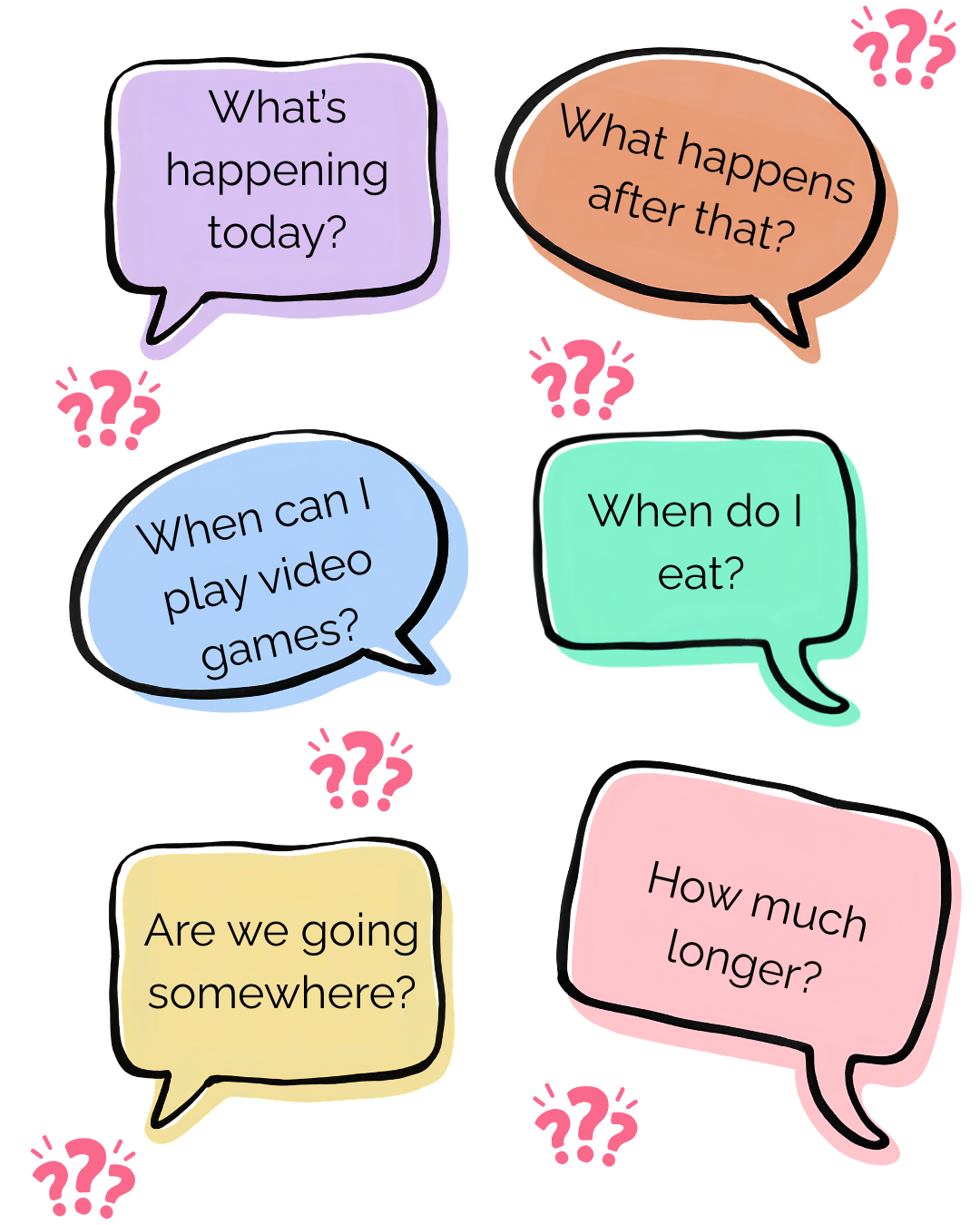
When kids do not have answers to those questions, their brains may have to work harder all day long. That can show up as irritability, anxiety, refusal, big emotions, clinginess, boredom, screen battles, or meltdowns that seem to come out of nowhere.
Sometimes the problem is not that a child is being difficult. Sometimes the problem is that the day has too many unknowns.
Structure Can Actually Make Summer More Fun
You may worry that adding routine to summer will make it feel less free or less fun. For many kids, structure is what makes fun possible.
Think about it this way: If your child knows they will have breakfast, get dressed, have some movement time, go on an outing, come home for lunch, have quiet time, and then get screen time later, they do not have to spend the entire morning asking what is happening next. They can relax into the day a little more.
We’re also not saying that every day needs to look the same. Just remember that your child may benefit from a few predictable anchors.
Some simple summer anchors might be:
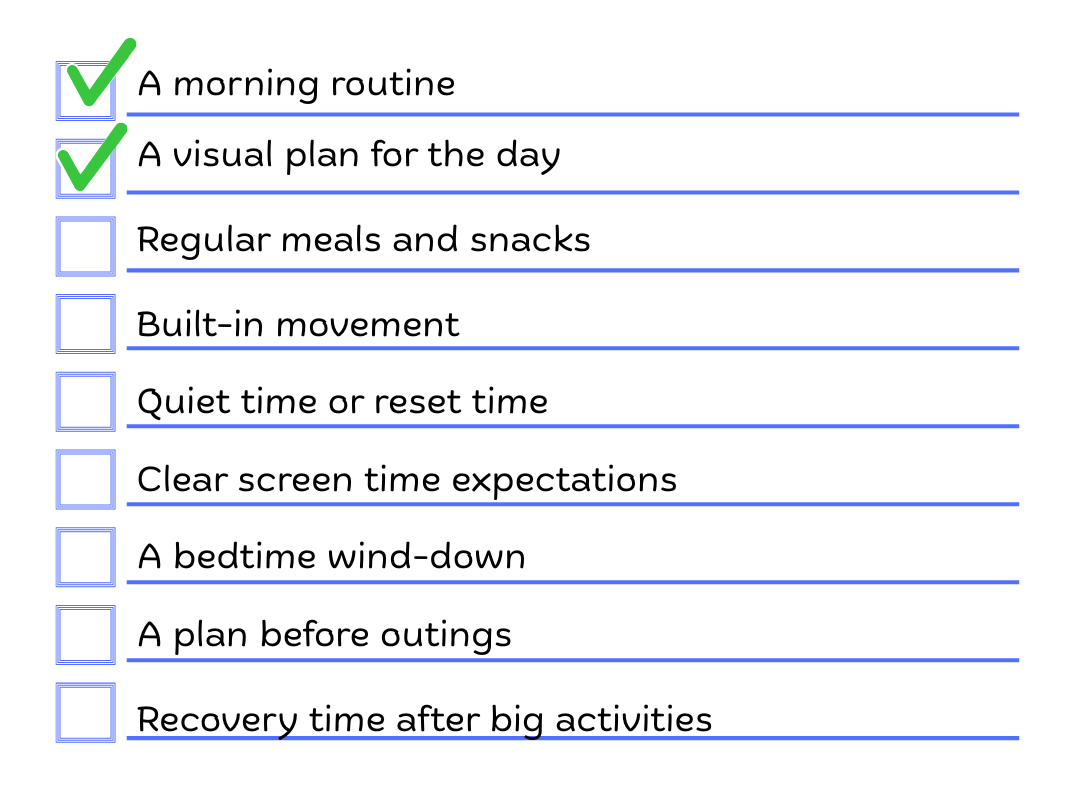
The goal is not to make summer look like school. The goal is to help your child’s brain and body feel less surprised all the time.
Summer Outings Can Be Fun (and Completely Overwhelming)
Museums, zoos, parks, libraries, nature trails, children’s museums, splash pads, and local day trips can be wonderful summer activities. They can also be a lot. Even when your child wants to go, they may still struggle with parts of the experience.
Summer outings often include:
That is a lot of input for a developing nervous system, and it is especially a lot for kids who are neurodivergent, anxious, sensory-sensitive, easily fatigued, or still building executive functioning skills.
To be honest, it is a lot for parents too. Nothing says “family memories” quite like carrying a backpack, three water bottles, a half-eaten granola bar, and a child who has suddenly decided they can no longer walk.
The Outing Does Not Have to Be Perfect to Be Meaningful
One thing we want parents to hear clearly is this:
When we pace outings with a child’s brain and body in mind, we are not lowering expectations. We are helping kids build the skills they need to enjoy new experiences over time.
You do not have to see the whole museum for the trip to count.
You do not have to read every sign.
You do not have to turn every moment into a lesson.
You do not have to stay until everyone is exhausted just because you paid admission.
For some kids, a successful outing might mean visiting two exhibits, taking a snack break, noticing one cool thing, and leaving before the meltdown.
That counts.
In fact, that may be the most successful version of the trip!
Our 5 Tips for Outings
1) Before You Go: Preview the Plan
One of the simplest ways to support neurodivergent kids during summer outings is to preview the plan before you leave.
This does not need to be complicated.
You might say:
“We are going to the science museum this morning. We will stay for about two hours. We are going to see the dinosaur exhibit first, then choose one more area. We will take a snack break if your body needs one. If it gets too loud or crowded, we can step outside or find a quiet spot.”
That little preview gives your child a map for the experience.
You can also show pictures of the location, look at a map together, talk about parking, discuss bathrooms, or choose a few must-see areas ahead of time.
This helps with anxiety, transitions, planning, flexibility, and emotional regulation.
It also reduces the number of decisions your child has to make once they are already in a busy environment.
2) Give Your Child a Mission
Kids often do better when they have a job. Not a chore. Not homework. A mission.
Instead of walking into a museum, zoo, or park and saying, “Go explore,” try giving your child something specific to look for.
For example:
A mission gives the brain a focus. It can help kids stay engaged, especially kids who may get overwhelmed by too many options.
It also turns the outing into something interactive without making it feel like a school assignment.
3) Ask Better Questions
We have all asked a child, “Did you have fun?” and received the deeply emotional answer of, “Yeah.”
If you want more connection, try asking questions that invite curiosity instead of performance.
Here are a few to try:
These questions help kids reflect, connect, and communicate. They also give parents useful information about what worked and what did not.
And if your child does not want to answer right away, that is okay too. Some kids process later. The best conversation may happen in the car, at bedtime, or two days later while you are trying to unload the dishwasher.
Because children do enjoy choosing mysterious timing.
4) Use Special Interests as a Bridge
If your child loves Pokémon, Minecraft, Roblox, dinosaurs, bugs, trains, animals, art, maps, weather, or space, use that interest.
Special interests can be powerful bridges into learning, connection, and engagement.
For example:
If your child loves Pokémon, ask:
If your child loves Minecraft, ask:
If your child loves Roblox, ask:
If your child loves dinosaurs, ask:
This is not “giving in” to the interest. This is meeting your child at the doorway their brain already wants to walk through.
5) Plan Breaks Before Everyone Falls Apart
One of the biggest mistakes families make during outings is waiting too long to take a break. We often wait until a child is already melting down, refusing, bolting, whining, yelling, or lying on a bench like a Victorian ghost. Oops!
Try building in breaks before things get intense.
A break might be:
Leaving early is not failure. Leaving before everyone is completely fried is actually a very wise parenting move. It helps your child learn that their body signals matter. It also makes it more likely that they will want to try another outing in the future. Win!
Introducing Our Summer Adventure Passport
To help families make summer outings more manageable and more meaningful, we created our free printable:
The Summer Adventure Passport
This printable is designed to help kids and parents add a little structure, curiosity, and regulation to museums, zoos, parks, libraries, nature trails, children’s museums, and local day trips.
It is not meant to be another worksheet.
It is a simple tool to help your child:
Parents can use it at places like the Museum of Life and Science, the NC Museum of Natural Sciences, Marbles Kids Museum, the NC Zoo, local parks, libraries, trails, or even a walk around town. Use it before your next outing to help your child stay curious, regulated, and engaged.
Because sometimes kids do not need a more expensive activity. Sometimes they just need a little more structure around the activity they are already doing.
Offices in Cary, Chapel Hill, and Fuquay Varina, NC