
Executive Functioning Therapy
Executive Functioning Therapy
Executive Functioning Therapy
Helping Your Brain Manage Life: Focus, Plan, Regulate, Achieve
If your child is bright, capable, and full of potential, but still struggles to get started, stay organized, follow through, complete reading or writing assignments, manage emotions, or keep up with daily demands, executive functioning may be part of the picture.
At Be A Problem Solver Services, we provide executive functioning support for children, teens, and young adults in Cary, Chapel Hill, and Fuquay-Varina. We help build the skills behind independence, follow-through, self-management, and success at home, at school, and in everyday life.
Executive Functioning Therapy
Helping Your Brain Manage Life: Focus, Plan, Regulate, Achieve

If your child is bright, capable, and full of potential, but still struggles to get started, stay organized, follow through, complete reading or writing assignments, manage emotions, or keep up with daily demands, executive functioning may be part of the picture.
At Be A Problem Solver Services, we provide executive functioning support for children, teens, and young adults in Cary, Chapel Hill, and Fuquay-Varina. We help build the skills behind independence, follow-through, self-management, and success at home, at school, and in everyday life.
Click to go directly to one of the following sections:
What Is Executive Functioning?
The Basics
Executive functioning is the brain’s self-management system. It includes the brain-based skills that help us plan, organize, begin tasks, manage time, remember information, regulate emotions, shift between tasks, and follow through.
You can think of executive functioning as the CEO of the brain, helping organize all the moving parts so a child can manage daily life with more confidence, control, and flexibility.
A child with executive functioning challenges often knows what to do, but struggles to do it consistently. They may have the ability, but not yet have the systems, regulation, or self-management skills to carry it out smoothly.
Executive functioning challenges can affect:
These struggles are common in neurodivergent children and teens, including those with ADHD, autism, anxiety, learning differences, and twice-exceptional, or 2e, profiles. They can also show up in children without a formal diagnosis.
Signs Your Child May Be Struggling
Recognizing It
Executive functioning challenges can show up in many different ways.
Your child might:
These struggles are real, frustrating, and often misunderstood. They are not simply about laziness, lack of intelligence, or not trying hard enough.
How Executive Functioning Support Works
The Process
Executive functioning support begins with a comprehensive intake evaluation. This helps us understand your child’s strengths, challenges, daily demands, and what kind of support may be the best fit.
Our executive functioning intake helps us better understand how your child manages life at home, at school, and in everyday routines.
During the intake, we may look at:
The intake may include parent or caregiver interview, discussion of concerns and history, direct interaction with your child or teen, observation, structured tasks and activities, and review of current functioning across settings.
The goal is not simply to say that executive functioning is “hard.” The goal is to understand how it is affecting your child’s daily life and what support is most appropriate moving forward.
After the evaluation, you will receive a written report.
This report typically includes:
Executive functioning sessions are practical, supportive, and individualized. Sessions focus on skill-building, problem-solving, and helping your child function more successfully in daily life.
Depending on your child’s age and needs, sessions may focus on:
Parent involvement is an important part of executive functioning support. These skills usually do not improve from one session a week alone, so we help parents understand what is getting in the way and how to support skill-building outside of sessions.
There may be practice between sessions, such as using new tools, building routines, or supporting follow-through at home. Our goal is to help your child build strategies that work in real life, not just during the session.
We use evidence-informed tools and frameworks based on your child’s needs, which may include Declarative Language, Zones of Regulation, Social Thinking, Cognitive Connections, Seeds of Learning, Lindamood-Bell strategies, and other individualized supports.
What Sets Us Apart
Why an SLP-Led Evaluation Matters
Executive functioning challenges rarely happen in isolation. Skills like following directions, completing reading and writing assignments, managing emotions, organizing thoughts, advocating for needs, and navigating social situations all rely heavily on language and communication.
That is why our executive functioning intake evaluations are completed by a licensed Speech-Language Pathologist.
Often a child’s struggles may look like ADHD, poor motivation, avoidance, or “not listening,” when there may actually be an underlying language, communication, auditory processing, literacy, or learning-related challenge contributing to the difficulty.
Full evaluations provide individualized, clinical goals that are targeted and measurable, and can provide valuable information and insight into your child’s learning style and possible clinical diagnoses.
Coaching
Executive functioning coaching can be very helpful for building systems, routines, and strategies. However, coaching is different from a clinical evaluation. A licensed Speech-Language Pathologist can assess and diagnose communication and language-based concerns that may be impacting your child’s ability to function at home, at school, and in daily life.
What We May Identify During Evaluation
Clinical Depth
An SLP-led executive functioning evaluation may help identify underlying skills that affect daily functioning, school performance, communication, and independence.
Some children have difficulty understanding spoken directions, classroom language, multi-step instructions, abstract concepts, or questions. This can look like a child is not paying attention, ignoring directions, or forgetting what was said, when they may not have fully understood the information in the first place.
Other children know what they want to say but struggle to organize their thoughts, retrieve words, explain ideas clearly, or answer questions fully. This can affect writing assignments, class participation, problem-solving, self-advocacy, peer relationships, and emotional expression.
An evaluation may help identify receptive language difficulties, expressive language difficulties, or Developmental Language Disorder, also known as DLD. DLD can be missed because a child may be bright, funny, creative, and conversational, while still struggling with academic language, reading comprehension, written expression, directions, or explaining their thinking.
Some children can hear normally but still have difficulty making sense of what they hear, especially in busy classrooms, group conversations, noisy environments, or when information is presented quickly.
This may look like:
Because auditory processing, language processing, attention, and working memory can overlap, an SLP-led evaluation can help identify whether a child’s listening challenges may be connected to language, communication, executive functioning, or learning demands.
When concerns suggest a possible Central Auditory Processing Disorder, we may recommend additional testing with an audiologist as part of a more complete evaluation plan.
Executive functioning challenges often show up during reading and writing tasks because these activities require planning, organization, memory, attention, language, and follow-through.
Speech-Language Pathologists are trained to assess the sound structure of language, which is closely connected to reading and spelling development. An evaluation may identify difficulty with phonological awareness skills such as rhyming, blending sounds, segmenting words, decoding, or spelling patterns.
An SLP may also look at narrative language, which is the ability to tell, retell, and understand stories or events in an organized way. Children use narrative language when they explain what happened at school, summarize a book, write an essay, describe a problem, or tell an adult about a conflict with a peer.
When narrative skills are weak, a child may sound scattered, leave out important details, or struggle to explain cause and effect.
Some children struggle with the unwritten rules of communication, such as understanding tone, body language, perspective-taking, humor, sarcasm, conversational timing, or how to repair misunderstandings.
These challenges may affect friendships, group work, classroom participation, emotional regulation, and confidence.
An SLP evaluation may also identify speech sound concerns, stuttering or fluency concerns, and voice or resonance differences that may affect communication, confidence, participation, and self-advocacy.
Fees + Insurance
Logistics
Comprehensive executive functioning intake
$600
60-minute session
$140
45-minute session
$105
30-minute session
$70
Insurance & superbills
Executive functioning services are self-pay. We are not in network with insurance for executive functioning sessions.
Families may request a superbill for possible out-of-network reimbursement when services are provided by a licensed Speech-Language Pathologist. Reimbursement is not guaranteed and depends entirely on your insurance plan and out-of-network benefits.
Frequently Asked Questions
Good Questions
Executive functioning services are self-pay. We are not in network with insurance for EF sessions. Some families may choose to submit a superbill for possible out-of-network reimbursement when services are provided by a licensed Speech-Language Pathologist.
A superbill is an itemized receipt you can submit to your insurance company if you want to request possible out-of-network reimbursement. It does not guarantee payment, and reimbursement depends on your individual plan.
We are happy to review previous testing, and those reports can provide very helpful background information. In many cases, however, psychological or educational evaluations do not take a deep enough look at executive functioning in a way that helps guide ongoing EF treatment.
A previous report may identify concerns with attention, organization, working memory, planning, or self-regulation, and it may even recommend executive functioning therapy. But it often does not fully show how those challenges are affecting your child at school, in day-to-day life right now, or what specific supports and strategies would be most helpful in treatment.
Our executive functioning intake is designed to look more closely at the practical skills your child uses to manage daily demands at home, at school, and in everyday routines. We use that information to make individualized recommendations and build a treatment plan that fits your child’s current needs.
Previous testing gives us background. Our intake helps us plan individualized treatment.
This is a common question, especially when parents hear the word “speech” and think only about articulation, stuttering or the way speech sounds.
Actually, Speech-Language Pathologists are trained in a diverse range of cognitive processes that impact language, brain function (cognition), swallowing, speech, hearing, and voice. During schooling, clinicians learn about all of these processes, but many clinicians choose to specialize in a specific area. At our practice, our clinicians have specialized clinical training in executive functioning, education, and language.
Executive functioning is closely connected to language, processing, organization, comprehension, memory, and the ability to plan, explain, and carry out tasks. A licensed Speech-Language Pathologist is trained to evaluate many of the underlying skills that affect how a child takes in information, organizes it, and uses it effectively.
That matters because oftentimes a person’s challenges are not just about being disorganized. They may also involve how the person is processing language, understanding directions, organizing thoughts, or managing the language demands of school and daily life. It is extremely common for people with executive functioning challenges to have difficulty with reading and writing, as these processes are rooted in language and cognition.
Having the intake completed by an SLP helps us build a stronger clinical picture and make more informed recommendations from the start.
We are looking at the skills that affect daily functioning, including organization, planning, working memory, task initiation, emotional regulation, flexible thinking, follow-through, and how those challenges show up in real life at home, at school, and in everyday routines.
We do not use a one-size-fits-all testing approach; this is actually called “dynamic evaluation.” The evaluation may include parent interview, clinical observation, structured tasks, rating scales, and other measures selected based on your child’s age, needs, and presenting concerns. Examples of some forms that you or your child may be asked to complete include the Brief-2, The McCloskey Executive Functioning Scales, The Self-Q, The Kaufman Interview, and several others.
No. Tutoring focuses on academic content. Executive functioning support focuses on the skills that help a child manage tasks, stay organized, plan ahead, start work, follow through, regulate emotions, and function more independently. We may use schoolwork, planners, backpacks, or current assignments as tools for practice — in fact, we prefer that so that we are not giving the child “extra” work. These services may complement one another, but they are not the same thing.
That depends on your child’s age, needs, goals, and the level of support needed. Many families begin with weekly sessions, while others may meet less often depending on the situation. We make recommendations based on the intake findings and your child’s treatment goals. Session length will also vary based on your child’s stamina and treatment plan.
That is a completely reasonable question.
Executive functioning support is not always necessary for every child, and we never want families to feel like they need to add one more appointment just for the sake of it. But for some children and teens, executive functioning challenges are a major reason life continues to feel hard even when they are already in therapy.
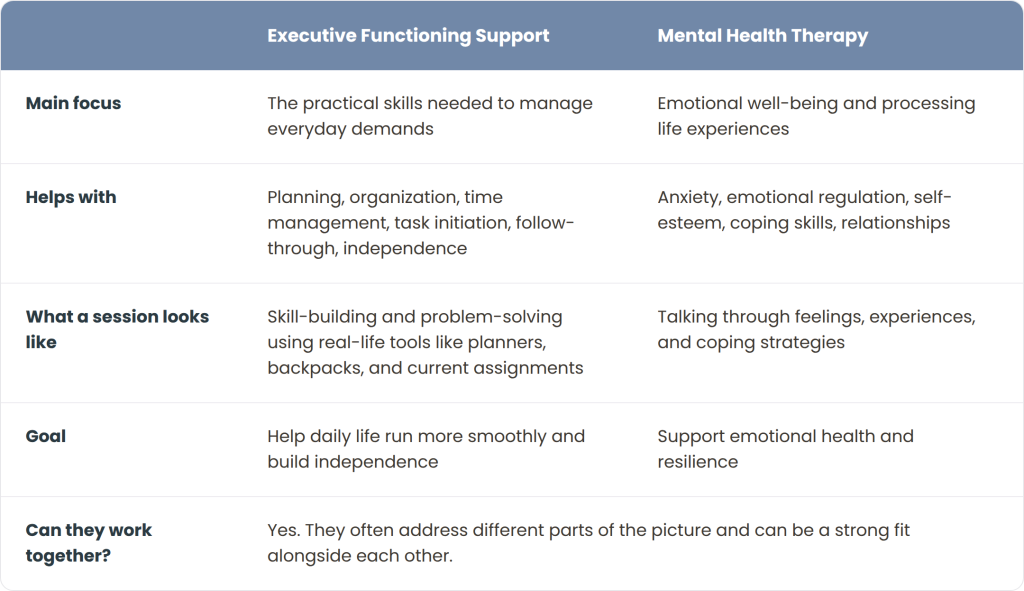
Therapy can be incredibly helpful for things like anxiety, emotional regulation, self-esteem, coping skills, relationships, and processing life experiences. Executive functioning support is different. It focuses more directly on the practical skills needed to manage everyday demands, such as planning, organization, time management, follow-through, task initiation, and independence.
In some cases, therapy and executive functioning support work very well alongside each other because they are addressing different parts of the picture. For example, a child may need therapy to manage overwhelm, anxiety, or frustration, while also needing executive functioning support to build the tools and systems that help daily life run more smoothly.
That said, more services is not always better. We consider the whole child, the family’s schedule, and whether this support makes sense right now. Sometimes executive functioning support is a strong fit alongside therapy. Sometimes it makes more sense to wait. Our goal is to make thoughtful recommendations, not overload your child.
Resources
For Families
If you are starting your journey into executive functioning therapy and would like to learn more, please check out our favorite resources.
Executive Functioning vs. Mental Health Therapy
Clearing It Up
Ready To Learn More?
If your child is struggling with follow-through, organization, emotional regulation, planning, or independence, executive functioning support may help.
We would be glad to help you better understand what is going on and what next steps may be the best fit for your child.
