
Is It Defiance or a Lagging Skill? Understanding Challenging Behavior From Elementary Through High School
Your child knows how to put on their shoes. Your middle schooler has completed homework before. Your teenager definitely understands that assignments have deadlines.
So when they refuse, forget, argue, shut down, or wait until the last possible minute, it can feel intentional and frustrating. They can do it, so why aren’t they doing it?
Sometimes the issue is motivation or consistency. Sometimes a clear expectation and a well-designed behavior plan can help. But sometimes what looks like defiance is actually a sign that a child cannot reliably access the skills the situation requires, particularly when they are stressed, tired, distracted, overwhelmed, or upset.
Before deciding how to respond, it helps to ask a different question: What might be making this hard for my child right now?
What is a Lagging Skill?
Kaitlin Graham, LCSW, says, “A lagging skill is a skill a child or teen has not developed fully enough to meet a particular expectation consistently.” The idea is closely connected to the reminder that children generally do well when they can, not simply when they want to.
Lagging skills may involve:
Recognizing a lagging skill does not mean ignoring behavior, eliminating expectations, or letting a child do whatever they want. Instead, it means identifying the barrier so we can teach and support the skill instead of repeatedly punishing a child for not yet using it successfully.
“But I’ve seen my child do it before”
This is where things get tricky. A child may be able to use a skill in one setting but struggle to access it in another. They may handle a change well on a calm Saturday afternoon but fall apart when plans change after a long school day. A teen may organize a project related to a favorite interest but feel completely stuck when faced with a multi-step history assignment.
Being able to do something sometimes is different from being able to do it independently, consistently, and under stress.
That does not automatically mean every difficult behavior comes from a lagging skill. It does mean that inconsistency deserves curiosity before we jump to conclusions.
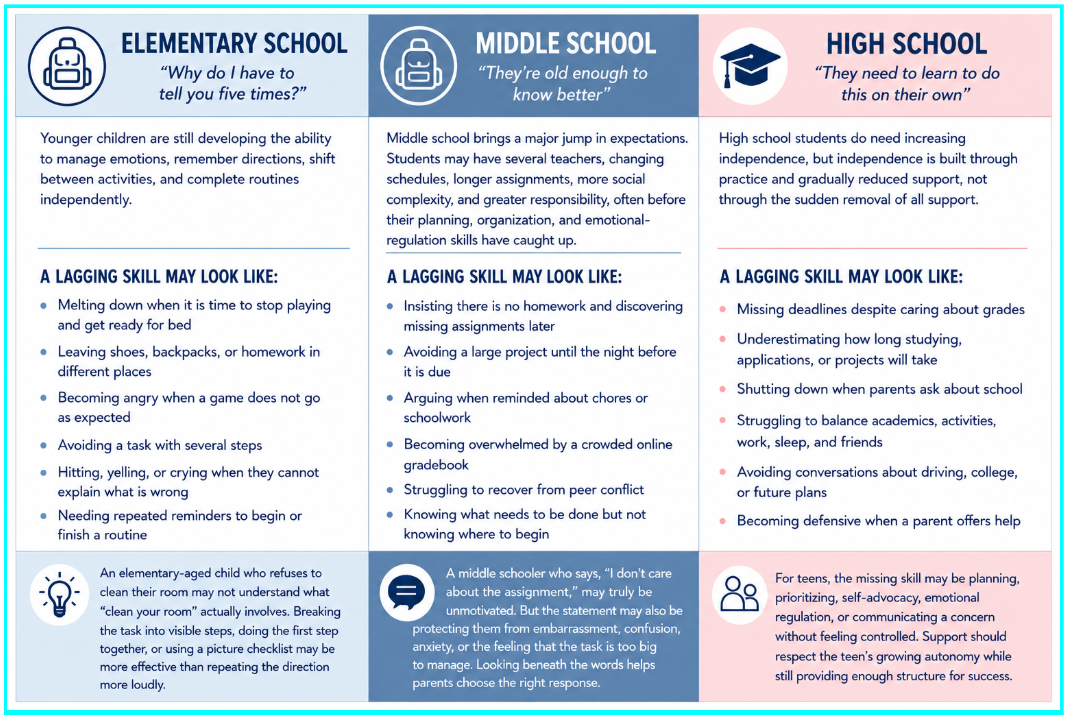
What Lagging Skills Can Look Like at Different Ages
The expectations change as children grow, so the behavior may look different even when the underlying skill is similar.
What Should Parents Do When a Skill is Missing?
If your child does not yet have the skill - or cannot use it consistently - the goal is to teach, support, scaffold, model, and practice.
That might include:
One useful approach is a Plan B conversation. The parent begins by listening to the child’s concern, then explains the adult’s concern, and finally invites the child to help develop a realistic solution that addresses both.
For example, instead of beginning with, “You need to stop arguing and do your homework,” a parent might say, “I’ve noticed it has been really hard to start math after school. What’s up?” The goal is not to talk a child into compliance. It is to learn what is making the expectation difficult and work toward a solution both people can try.
Just remember, these conversations are most productive when everyone is calm, not in the middle of a power struggle.
What if My Child Has the Skill but Still is Not Doing It?
Sometimes a child understands the expectation and has the necessary skills but is distracted, forgetful, inconsistent, or not sufficiently motivated. In those situations, a behavior plan may be useful.
Effective behavior plans are more than a random sticker chart that appears on Monday and is forgotten by Thursday. A helpful plan:
Just saying “Be responsible” is too broad. “Put your backpack by the door before screen time” is clear and observable.
It is also important to make sure another lagging skill is not interfering. A child may be motivated by the reward but still lack the planning, memory, emotional regulation, or task-initiation skills needed to earn it. Let’s be honest, no prize is magical enough to replace a missing skill.
A Simple Decision Process for Challenging Behavior
When a frustrating behavior keeps happening, consider these questions:
1) Does my child know how to do what I am asking, and can they do it consistently in this situation?
If not, identify the likely missing skill and consider teaching, practicing, scaffolding, or having a collaborative Plan B conversation.
2) If the skill is present, is this primarily a motivation or consistency issue?
If so, a carefully designed behavior plan may help.
3) If neither explanation seems to fit, could another lagging skill be getting in the way?
Look at what happens immediately before the behavior, when it is most likely to occur, and what makes the situation easier or harder.
You do not have to solve every difficult routine at once. Choose one recurring challenge, such as bedtime, homework, chores, sibling conflict, morning routines, or screen time, and begin there.
Learn How to Choose the Right Response
On September 24 at 6:30 p.m. ET, therapist Kaitlin Graham, LCSW, will lead Defiance or Difficulty? What’s Really Behind Your Child’s Behavior, a live virtual workshop for parents of elementary, middle, and high school students.
Kaitlin will help parents recognize common lagging skills, look beneath challenging behavior, use a collaborative Plan B conversation, and understand when and how to create a behavior plan that works. She will share practical examples, common mistakes, and a simple decision-making tool parents can use at home. The workshop will also include time for questions.
Be a Problem Solver Services has offices in Chapel Hill, Cary, and Fuquay-Varina, North Carolina, but this workshop is fully virtual. Parents may register from anywhere.
Register online today to reserve your spot.
Offices in Cary, Chapel Hill, and Fuquay Varina, NC
