
Back-to-School Support for Executive Functioning, Anxiety, and Emotional Regulation
The backpack is packed. The first-day outfit has been approved. The school supply list has been completed, or at least completed enough that nobody needs to make an emergency trip for glue sticks at 9:00 p.m.
Your child makes it through the first few days of school, and everything seems surprisingly fine. Maybe they even seem excited.
That is wonderful, but it does not necessarily tell you how the rest of the school year will go.
The first week of school is filled with novelty, extra structure, repeated directions, relationship-building activities, and a little more patience from everyone. Teachers are teaching routines. Assignments may still be light. Students are often running on a mixture of excitement, adrenaline, and determination.
Some children can hold things together exceptionally well during this period. The more noticeable struggles may not appear until several weeks later, once the novelty fades and the expectations increase.
This is sometimes described as a back-to-school “honeymoon period.” It does not mean your child was pretending or that problems suddenly appeared out of nowhere. It may simply mean that the full executive functioning, academic, sensory, social, and emotional demands of school have finally arrived.
Back-to-School Requires More Than Academic Skills
When adults think about preparing a child for school, we tend to focus on school supplies, transportation, class schedules, and academics.
But students are also being asked to:
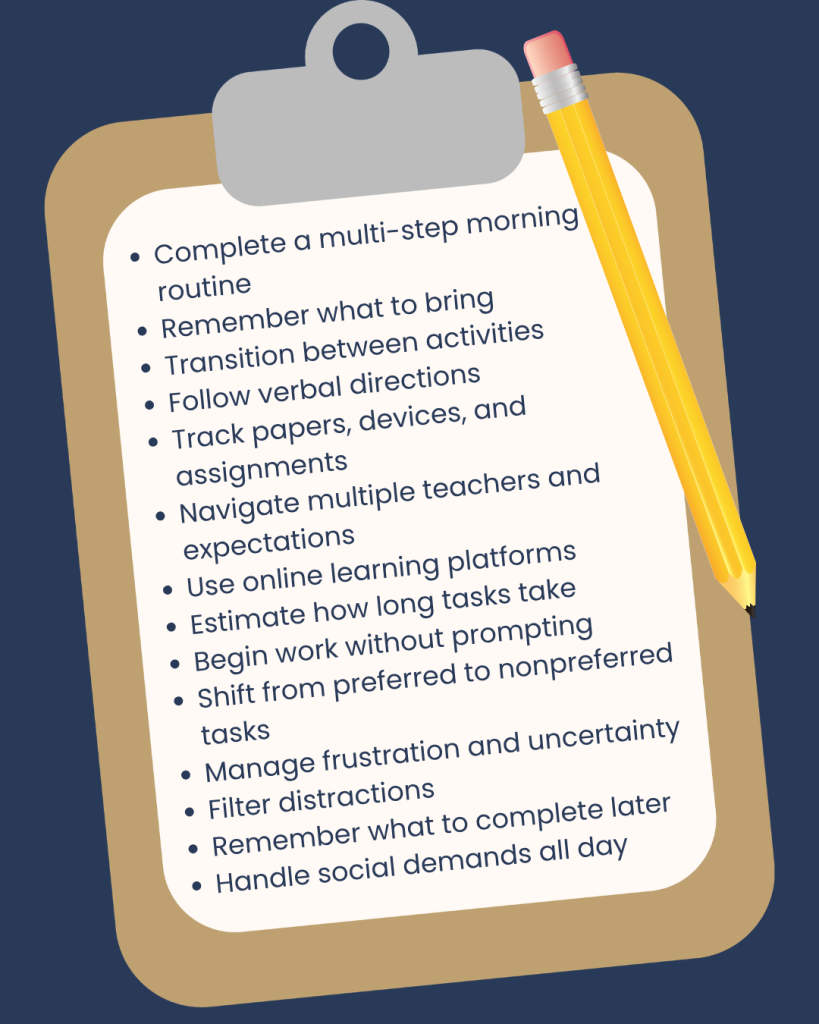
Those are executive functioning demands.
Executive functioning includes the mental skills involved in planning, organizing, beginning tasks, managing time, holding information in mind, regulating emotions, and adjusting when something changes. A child can be bright, curious, creative, and academically capable while still struggling significantly with these skills.
That is why “But you know how to do this” is not always as helpful as we hope it will be. Knowing how to complete a task and being able to organize yourself to complete it consistently are two different things.
When a Bright Child Cannot Get Ready Without Constant Reminders
School mornings are a common place for executive functioning challenges to show up.
A parent may say:
“I have told him four times to put on his shoes.”
“She was completely dressed, and then she started reorganizing her desk.”
“He knows exactly what time the bus comes, but he acts surprised every morning.”
“She can explain the entire routine, but she cannot complete it without me standing there.”
These behaviors can look careless, irresponsible, or even oppositional. But the difficulty may involve:
Working memory: Holding the next step in mind while completing the current one.
Task initiation: Shifting from thinking about a task to actually beginning it.
Sequencing: Completing steps in a useful order.
Time awareness: Accurately sensing how much time has passed and how much remains.
Attention regulation: Staying connected to the routine when something more interesting appears.
Cognitive flexibility: Adjusting when the preferred shirt is dirty, breakfast is different, or the family is running late.
Instead of adding more verbal reminders, try moving some of the routine outside your child’s brain.
A short visual checklist, posted schedule, timer, labeled “launch pad” for school items, or evening preparation routine can reduce the number of things your child has to remember independently. Breaking routines into smaller steps and using visual prompts can be especially helpful for children with ADHD, autism, working-memory challenges, or executive dysfunction.
The goal is not to do everything for your child. The goal is to create enough structure that your child can practice doing more for themselves.
Some Kids Need to Know Every Detail
For children who struggle with uncertainty, “You’ll find out when you get there” is rarely reassuring.
Children with anxiety, autism, sensory sensitivities, or difficulty with transitions may need more information before school begins. They may be wondering:
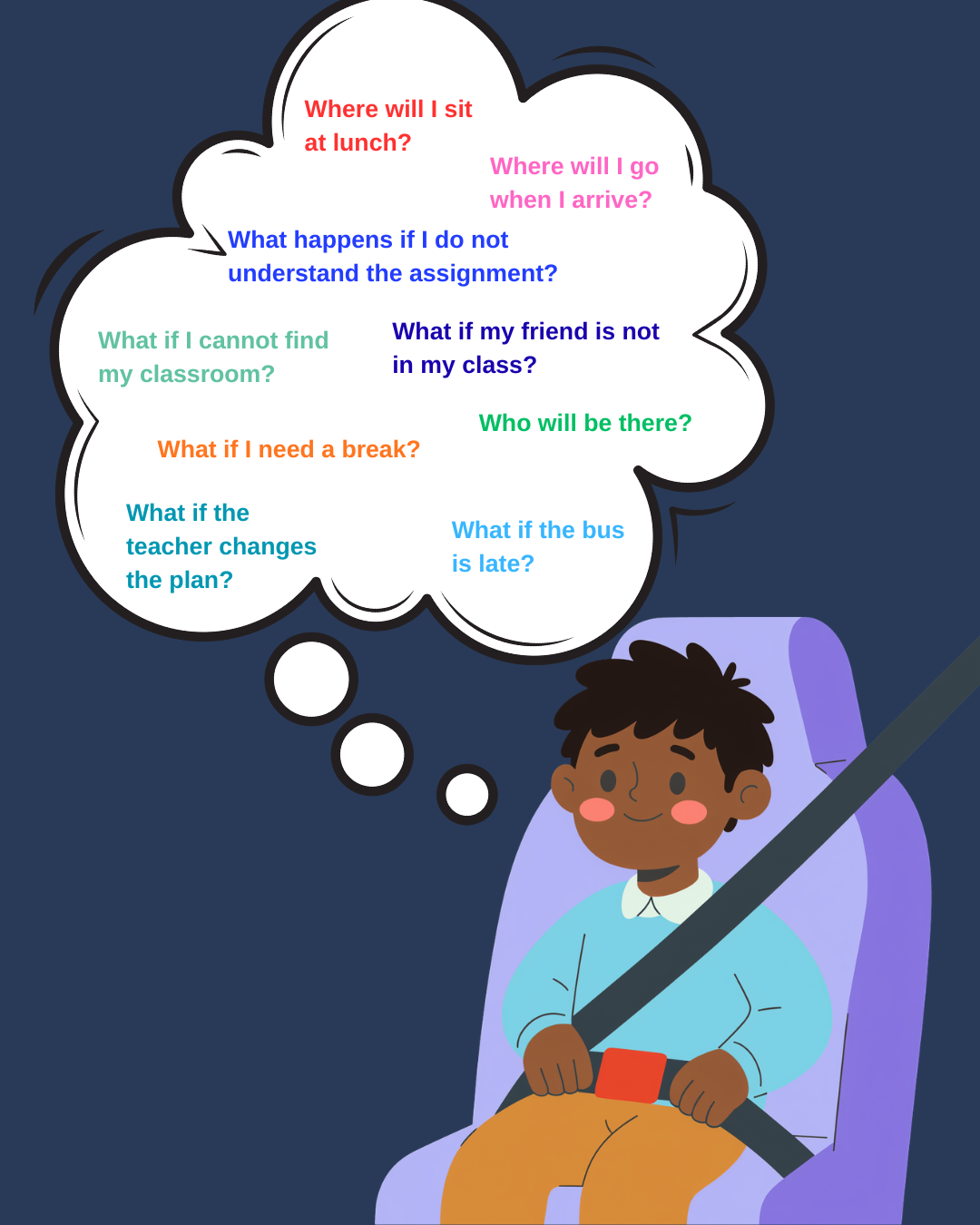
Adults sometimes avoid discussing these concerns because we do not want to “feed the anxiety.” But calm preparation is different from participating in an endless cycle of reassurance.
You can help by:
Predictable routines, previews, countdowns, and visual cues can make transitions more manageable for children with ADHD, anxiety, autism, and sensory needs. Preparation cannot remove every unknown, but it can help your child feel more capable of handling one.
Why Some Kids Melt Down After School but Seem Fine All Day
One of the most confusing parts of back-to-school season is hearing, “They’re doing great!” from the teacher, only to have your child completely fall apart the minute they get home. They may cry, argue, refuse the simplest request, hide in their room, get extra silly, or have a huge reaction to something that seems incredibly small.
It can feel like they’re holding it together at school and choosing not to at home, but that usually isn’t what’s happening. All day long, your child may be working hard to listen, stay organized, handle noise and distractions, figure out social situations, move from one activity to the next, and meet everyone’s expectations. By the time they walk through the door, they may have very little patience, flexibility, or energy left.
And home is where they feel safest. You are their safe place, the person they don’t have to hold it together for anymore. That doesn’t make the after-school meltdowns easy, but it can help to remember: this may be less about “bad behavior” and more about a child who has simply used up everything they had.
Consider building a decompression period into the after-school routine. Depending on the child, that might include a snack, movement, outdoor time, quiet, music, sensory input, or time without questions.
Try not to launch immediately into a barrage of questions like:
“How was your day?”
“Do you have homework?”
“Why is your water bottle still full?”
“Did you turn in that form?”
Those may all be important questions and they may simply need to wait fifteen minutes.
The Backpack Is Probably Not the Whole Problem
By late September, your child’s backpack may be developing its own ecosystem. Inside, you might find crumpled papers, three pencils without erasers, an overdue library book, a permission slip you were supposed to sign last week, a mysterious granola bar wrapper, and an assignment your child insists the teacher never mentioned.
It’s easy to see the backpack as the problem, but ongoing disorganization often tells us something more. Your child may have trouble deciding where things belong, figuring out which papers are important, remembering to use the system they were taught, or simply slowing down long enough to put something in the right place.
A better binder might help, but it won’t automatically teach your child how to keep it organized. They may need a simpler system with fewer folders, a consistent place for everything, color coding, and a quick backpack reset built into the daily routine. Weekly cleanouts can help too, especially when an adult practices the system alongside them instead of simply telling them to “get organized.” When possible, working with the teacher can also help your child learn which materials should come home and which should stay at school.
Organization isn’t something children either naturally have or don’t have. It’s a skill they can learn with practice, support, and a system that works for their brain.
Back-to-School Support at Be A Problem Solver Services
At Be A Problem Solver Services, we help children, teens, young adults, and families better understand the connection between executive functioning, anxiety, emotional regulation, and behavior.
We offer mental health therapy and executive functioning support in Cary, Chapel Hill, and Fuquay-Varina, North Carolina, as well as select virtual services.
The first week of school is only the beginning. Give your child time to adjust, watch for patterns, and remember that struggling with the demands of school is not the same thing as lacking intelligence, motivation, or potential.
Offices in Cary, Chapel Hill, and Fuquay Varina, NC
